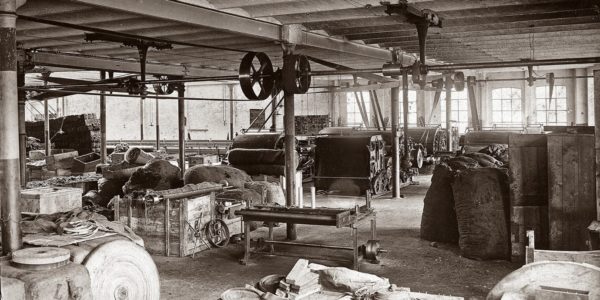
When Henry Poole opened its doors on Savile Row in 1846 as the street’s first tailoring house, Vitale Barberis Canonico had already been producing fine textiles in Biella, Italy, for over 180 years. By the mid 19th century, Vitale Barberis Canonico was rapidly increasing production and exporting across Europe, the Americas, and even to China, all made possible by the latest technology and machinery of the Industrial Revolution.
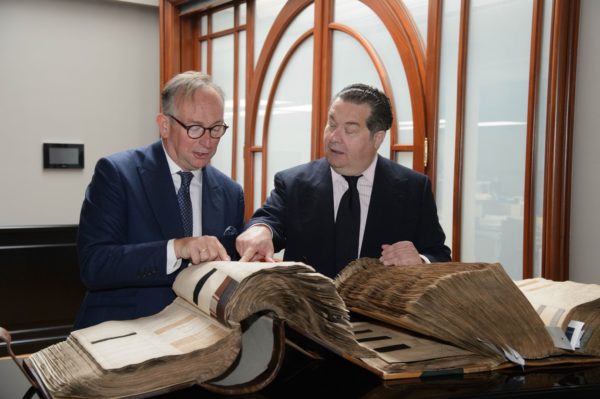
As Vitale Barberis Canonico continued to develop its Pratrivero mill, introducing mechanical frames and later electricity, Henry Poole was establishing its reputation within aristocratic circles through equestrian wear, field sports attire, and military uniforms. As both companies became world-renowned for their respective crafts, a notable crossover emerged in 1847, the future Emperor of France, Napoleon III, placed an order with Vitale Barberis Canonico for a “superfine blue” cloth. That same “superfine blue” appears in the Henry Poole archive as a new order for a silk lined coat.
“Two family-owned houses, shaped by centuries, united by craft, innovation, and an uncompromising respect for heritage.”
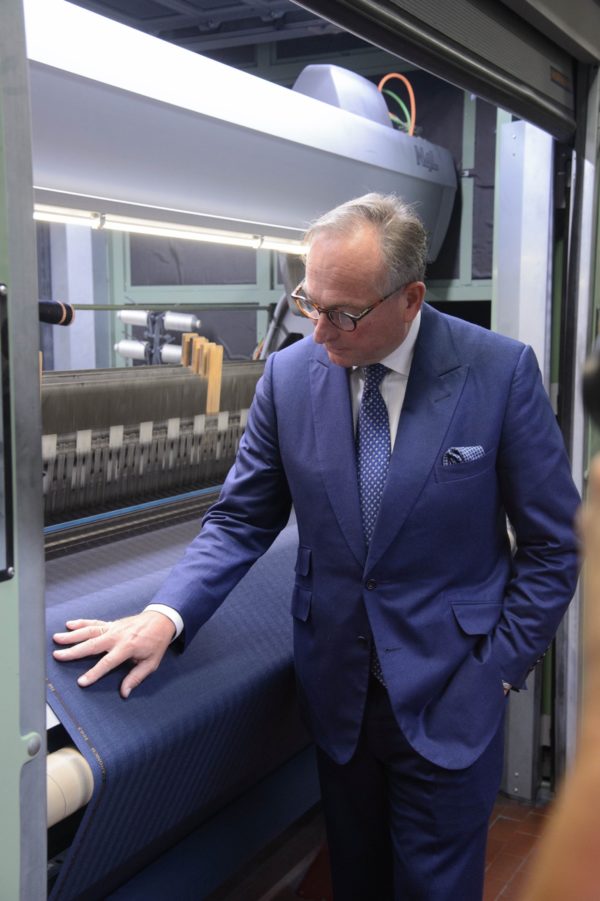
Today, both companies remain proudly family owned. Francesco Barberis Canonico, 13th-generation family owner and Marketing Director of Vitale Barberis Canonico, and Simon Cundey, 7th-generation owner and Managing Director of Henry Poole, continue to steward their houses with a shared respect for heritage and innovation.
Sustainability now sits at the heart of both businesses. Vitale Barberis Canonico has invested significantly in advanced water-filtration systems that not only dramatically reduce water usage throughout the production process, but also return water to nature fully purified. At Henry Poole, the bespoke model is inherently sustainable: garments are created in small quantities and crafted to last multiple lifetimes, with ongoing repair and restoration ensuring pieces remain in use for generations. This is further supported by a commitment to working with natural materials and mills with fully traceable wools, such as Vitale Barberis Canonico, allowing complete transparency on the journey from sheep to finished cloth.